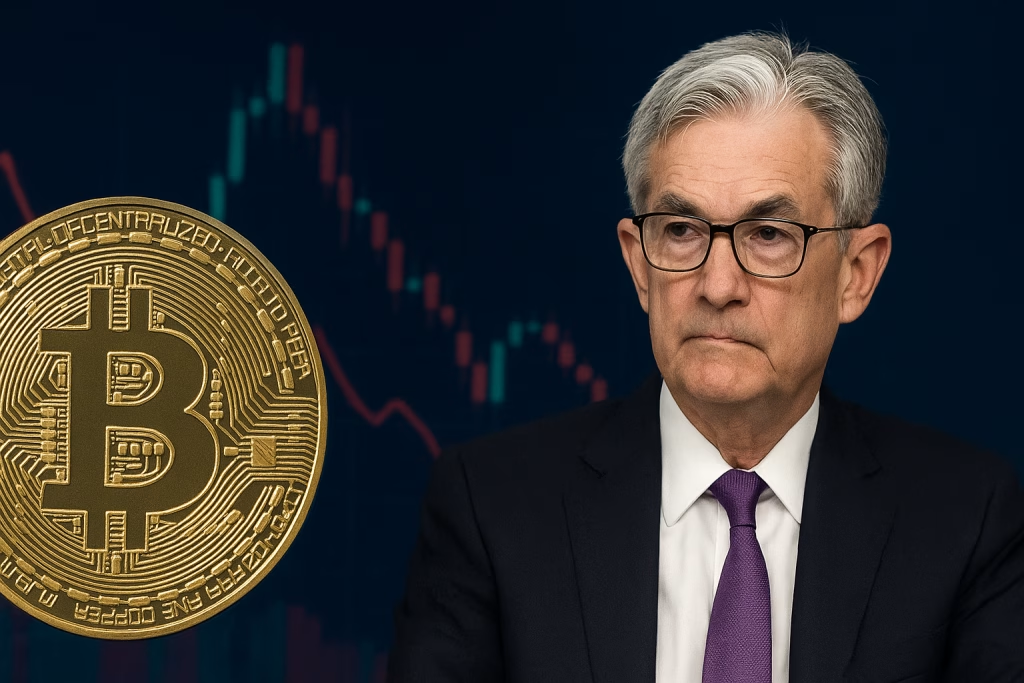
Prediction Markets Give $150K Bitcoin Low Odds, Is the Rally Running Out of Steam?

Bitcoin’s recent price action is forcing traders to reassess expectations for the rest of 2026. After a volatile start to the year, the world’s largest cryptocurrency is hovering around the high-$60,000 range, while prediction markets suggest the odds of a rapid surge to $150,000 are fading quickly.
On platforms such as Polymarket, traders are currently assigning roughly a 1% probability that Bitcoin will reach $150,000 by the end of March. Just a few months ago, that probability stood near 60% when Bitcoin was trading close to its all-time highs. The shift highlights how sentiment has cooled after a sharp correction and growing macroeconomic uncertainty.
At the time of writing, Bitcoin was trading near $67,000, giving it a market capitalization of around $1.27 trillion with nearly 20 million coins in circulation. Meanwhile, derivatives markets remain active, with about $44 billion in open interest tied to Bitcoin futures contracts across exchanges.
Prediction Markets Signal Cooling Optimism
Prediction markets allow traders to bet on future outcomes, often serving as a barometer of sentiment. The current low probability of a $150,000 Bitcoin price suggests traders expect limited upside in the near term.
Some analysts link the shift to Bitcoin’s historical four-year cycle, which typically includes a strong rally followed by a significant downturn. Previous downturns occurred in 2014, 2018, and 2022. If that pattern continues, 2026 could mark another corrective phase.
Bitcoin has already experienced notable volatility this year, with prices dropping significantly from earlier highs before stabilizing in the $60,000–$70,000 range. Some market watchers have even floated downside scenarios toward $40,000 or lower if broader risk appetite deteriorates.
Macro Pressures and Market Signals
Beyond internal market cycles, broader macroeconomic developments are also influencing crypto sentiment.
Geopolitical tensions, particularly escalating conflict in the Middle East, have increased oil prices and pushed investors toward caution across financial markets. Rising energy prices can lift inflation expectations and reduce the likelihood of near-term interest-rate cuts, tightening financial conditions for risk assets such as cryptocurrencies.
At the same time, on-chain and institutional activity paints a mixed picture. U.S. spot Bitcoin exchange-traded funds recently recorded $568 million in weekly inflows, suggesting continued institutional interest. However, some analysts note that large holders have begun taking profits while smaller investors increase exposure, often a pattern seen during market corrections.
Bitcoin’s Role Still Debated
Despite the volatility, some analysts argue Bitcoin continues to behave differently from traditional assets. Research from NYDIG suggests that although Bitcoin’s correlation with major equity indexes has risen, stock market movements explain only about 25% of its price changes, with the rest driven by crypto-specific factors such as ETF flows, derivatives positioning, and network adoption.
For now, the debate surrounding Bitcoin appears to be shifting. Instead of questioning whether the asset will survive, analysts and investors are increasingly discussing whether it could eventually serve as a sovereign reserve asset.
In the short term, however, prediction markets suggest traders remain cautious, leaving open the question of whether the current rally has more room to run.
About Author